
VOLUMETRIC TOLLENS REAGENT
SOLUTION
Store at 2C to 8C, protected 100 ML
Away from light
HS No. 38220090
Tollens’ reagent itself is a single solution (ammoniacal silver nitrate), but it is famously prepared as a two-part system
Tollens’ Reagent A and Tollens’ Reagent B—to be mixed just before use
Why are they separate?
Tollens’ reagent is highly unstable and can form explosive silver compounds (such as silver nitride) if stored for long periods. Because of this short shelf life, Reagents A and B are stored in separate bottles and only combined fresh when you are ready to perform a Tollens’ test (the “silver mirror” test)
Tollens’ Reagent A: This is an aqueous solution of Silver Nitrate (AgNO₃).
Tollens’ Reagent B: This is an aqueous solution of Sodium Hydroxide (NaOH) and Ammonia (NH₃)
How they work together:
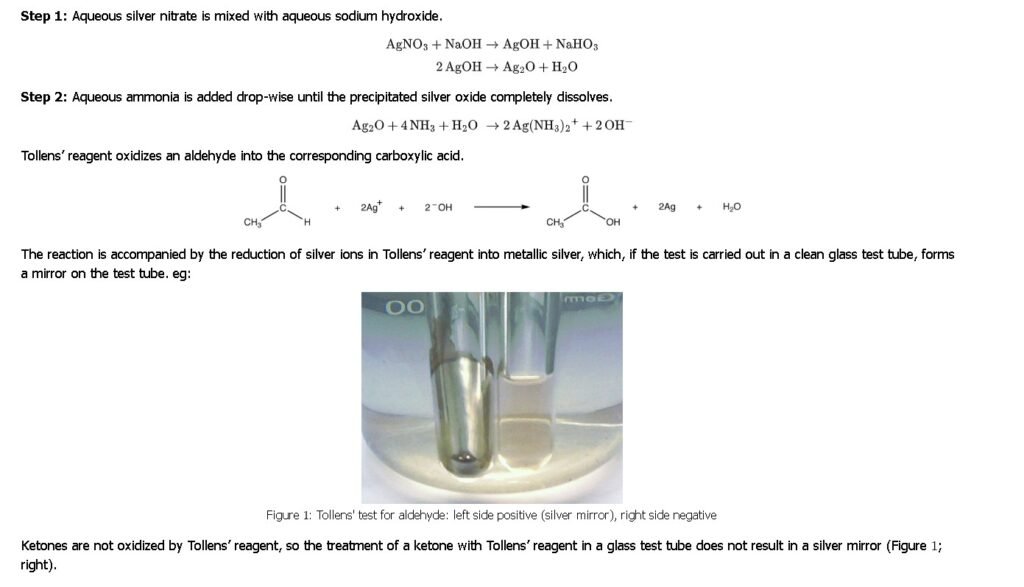
- Initial Mix: When you mix A and B, sodium hydroxide reacts with silver nitrate to form a brown precipitate of silver(I) oxide (Ag₂O). [1, 2]
- The Final Reagent: Ammonia is then added dropwise until the brown precipitate dissolves, leaving a clear, colorless solution. This final solution contains the active diammine silver(I) complex, \([Ag(NH_3)_2]^+\), which acts as the oxidizing agent. [1, 2]
- The Test: When an aldehyde is added to this mixture, it is oxidized into a carboxylic acid, while the silver ions are reduced into elemental silver, coating the inside of the test tube with a shiny “silver mirror”. [1, 2]
(Note: If you were thinking of the two-part system commonly referred to as Solution A and Solution B, you may be thinking of Fehling’s Reagent, which is used for a similar test. Fehling’s A is copper(II) sulfate and Fehling’s B is an alkaline tartrate solution). [1, 2]
Tollens’ test, also known as silver-mirror test, is a qualitative laboratory test used to distinguish between an aldehyde and a ketone. It exploits the fact that aldehydes are readily oxidized (see oxidation), whereas ketones are not. Tollens’ test uses a reagent known as Tollens’ reagent, which is a colorless, basic, aqueous solution containing silver ions coordinated to ammonia [Ag(NO3)2] . It is prepared using a two-step procedure.
==========================================================================================
Fehling Tollens Tests: Aldehyde vs Ketone Distinction
Aldehydes and ketones share the carbonyl group but differ significantly in their ease of oxidation. Consequently, fehling tollens tests provide simple chemical methods to distinguish between these two classes of compounds. Without these tests, you could not identify an unknown carbonyl compound quickly in the laboratory. Therefore, this chapter provides a complete, step‑by‑step guide to fehling tollens tests, specifically aligned with the FBISE curriculum for Grade 11 Chemistry, Chapter 19: Carbonyl Compounds. Moreover, you will learn the principles behind each test, the reagents involved, the chemical reactions, how to perform the tests, and how to interpret the results. As a result, you will confidently distinguish aldehydes from ketones using Fehling’s solution and Tollens’ reagent.
For more resources on fehling tollens tests and other chemistry topics, visit https://blog.zaheen.com.pk/, an online education study platform for students.
Table of Contents
- Section 1: Why Fehling Tollens Tests Are Classic Distinguishing Reactions
- Section 2: Principle of Oxidation – Aldehydes vs Ketones
- Section 3: Fehling’s Test – Reagents, Procedure, and Chemistry
- Section 4: Tollens’ Test – Reagents, Procedure, and Silver Mirror
- Section 5: Which Aldehydes Respond? Limitations of the Tests
- Section 6: Comparison Table – Fehling’s vs Tollens’ Test
- Section 7: Mechanism of Tollens’ Reaction (Simplified)
- Section 8: Common Mistakes
- Section 9: Practice Problems for Students on Fehling Tollens Tests
- Section 10: Frequently Asked Questions About Fehling Tollens Tests
- Final Words for Students on Fehling Tollens Tests
Section 1: Why Fehling Tollens Tests Are Classic Distinguishing Reactions
Aldehydes are easily oxidized to carboxylic acids, while ketones resist oxidation under mild conditions. Consequently, fehling tollens tests exploit this difference by using mild oxidizing agents that react only with aldehydes. Without these tests, distinguishing between an aldehyde and a ketone would require more complex instrumental analysis. Therefore, mastering fehling tollens tests is an essential practical skill for organic chemists.
Key Benefits
Provides a quick and inexpensive way to identify aldehydes.- Demonstrates the concept of oxidation in organic chemistry.
- Introduces the use of complexing agents (Fehling’s solution) and silver mirror formation (Tollens’ reagent).
- Helps in understanding the chemistry of reducing sugars (which contain aldehyde or ketone groups that can tautomerize).
Thus, fehling tollens tests are classic qualitative tests.
Section 2: Principle of Oxidation – Aldehydes vs Ketones
The key difference lies in the structure of the carbonyl group. This section of fehling tollens tests explains the chemical basis.
Aldehydes
- Have at least one hydrogen atom attached to the carbonyl carbon (R–CHO).
- Easily oxidized to carboxylic acids (R–COOH) by mild oxidizing agents.
Ketones
- Have two alkyl groups attached to the carbonyl carbon (R–CO–R’).
- No hydrogen on the carbonyl carbon; they resist oxidation under mild conditions. Strong oxidizing agents cause C–C bond cleavage (not a simple oxidation to a carboxylic acid).
Example 1
Acetaldehyde (CH₃CHO) is oxidized to acetic acid; acetone (CH₃COCH₃) does not react with Fehling’s or Tollens’ reagent.
Thus, fehling tollens tests rely on this fundamental difference in oxidizability.
Section 3: Fehling’s Test – Reagents, Procedure, and Chemistry
Fehling’s test uses a deep blue solution of copper(II) complexed with tartrate ions. This section of fehling tollens tests describes this test.
Reagents
- Fehling’s solution A: copper(II) sulfate solution.
- Fehling’s solution B: alkaline sodium potassium tartrate (Rochelle salt) and sodium hydroxide.
- Just before use, mix equal volumes of A and B to form the deep blue complex.
Procedure
- Add a few drops of the test compound to a clean test tube.
- Add 2 mL of freshly mixed Fehling’s reagent.
- Warm the mixture in a water bath (do not boil vigorously).
Positive Test
- A brick‑red precipitate of copper(I) oxide (Cu₂O) forms.
- Indicates the presence of an aldehyde (or an α‑hydroxy ketone, but not covered here).
Chemistry
- Aldehyde reduces Cu²⁺ (blue) to Cu⁺ (which forms Cu₂O, red precipitate). The aldehyde is oxidized to carboxylate.
Example 2
Formaldehyde (HCHO) + Fehling’s solution → Cu₂O (red) + formate ion.
Thus, fehling tollens tests give a positive result with aldehydes.
Section 4: Tollens’ Test – Reagents, Procedure, and Silver Mirror
Tollens’ test uses an ammoniacal silver nitrate solution. This section of fehling tollens tests explains this elegant test.
Reagents
- Tollen’s reagent: prepared by adding sodium hydroxide to silver nitrate solution, then dissolving the precipitated silver oxide with aqueous ammonia. (Do not store; use fresh.)
Procedure
- Clean the test tube thoroughly (any grease prevents silver deposition).
- Add a few drops of the test compound.
- Add 2 mL of Tollen’s reagent.
- Warm gently in a water bath (do not boil, as explosive silver azide may form if ammonia is present? Actually, handle with care).
Positive Test
- A silver mirror deposits on the inner wall of the test tube, or a grey precipitate forms (if the test tube is not perfectly clean).
- Indicates the presence of an aldehyde.
Chemistry
- The aldehyde reduces the diamminesilver(I) complex [Ag(NH₃)₂]⁺ to metallic silver. The aldehyde is oxidized to carboxylate.
Example 3
Acetaldehyde (CH₃CHO) + [Ag(NH₃)₂]⁺ → Ag(s) (silver mirror) + CH₃COO⁻ + NH₄⁺.
Thus, fehling tollens tests produce a beautiful silver mirror with aldehydes.
Section 5: Which Aldehydes Respond? Limitations of the Tests
Not all aldehydes give positive results under the same conditions. This section of fehling tollens tests discusses limitations.
Tollens’ Test
- Most aldehydes (aliphatic and aromatic) give a positive test.
- α‑Hydroxy ketones (e.g., benzoin, hydroxyacetone) can also give a positive Tollens’ test because they tautomerize to aldehydes.
Fehling’s Test
- Aromatic aldehydes (e.g., benzaldehyde) do NOT give a positive Fehling’s test because they are less reactive; the complexing agent affects the redox potential.
- Aliphatic aldehydes and α‑hydroxy ketones give positive Fehling’s test.
Example 4
Benzaldehyde gives a positive Tollens’ test but a negative Fehling’s test. This distinction can help identify the type of aldehyde.
Thus, fehling tollens tests have different selectivity.
Section 6: Comparison Table – Fehling’s vs Tollens’ Test
| Feature | Fehling’s Test | Tollens’ Test |
|---|---|---|
| Reagent | Cu²⁺ complex with tartrate, alkaline | [Ag(NH₃)₂]⁺ (ammoniacal silver nitrate) |
| Positive result | Brick‑red precipitate (Cu₂O) | Silver mirror or grey precipitate |
| Works with aliphatic aldehydes | Yes | Yes |
| Works with aromatic aldehydes | No (generally) | Yes |
| Works with α‑hydroxy ketones | Yes (after tautomerization) | Yes (after tautomerization) |
| Sensitivity | Moderate | High (detects very small amounts) |
| Test tube cleaning | Not critical | Very critical (grease prevents mirror) |
This table summarizes fehling tollens tests.
Section 7: Mechanism of Tollens’ Reaction (Simplified)
Understanding the redox chemistry helps. This section of fehling tollens tests outlines the electron transfer.
Simplified Steps
- The aldehyde reacts with water to form the gem‑diol (RCH(OH)₂).
- The gem‑diol is oxidized, and Ag⁺ is reduced to Ag⁰.
- RCHO + H₂O ⇌ RCH(OH)₂
- RCH(OH)₂ + 2[Ag(NH₃)₂]⁺ + 2OH⁻ → RCOO⁻ + 2Ag(s) + 4NH₃ + 2H₂O
Example 5
Formaldehyde gives a silver mirror even more readily.
Thus, fehling tollens tests involve a two‑electron transfer.
Section 8: Common Mistakes
- Using dirty glassware for Tollens’ test. Traces of grease prevent silver adhesion; the test fails even with an aldehyde.
- Allowing Fehling’s solution to stand too long before use. The mixed solution decomposes; always use freshly mixed reagent.
- Heating vigorously during Fehling’s test. Overheating may produce false positives from decomposition of some compounds.
- Assuming that all ketones give a negative test. α‑Hydroxy ketones can give positive tests due to enolization to aldehydes.
- Not distinguishing between aliphatic and aromatic aldehydes in Fehling’s test. Aromatic aldehydes give negative results, which could lead to misidentification if only Fehling’s test is used.
- Confusing the precipitate colors. Fehling’s gives a brick‑red Cu₂O; any other color indicates impurity or side reaction.
- Storing Tollens’ reagent. It forms explosive silver azide or silver fulminate on standing; always prepare fresh and destroy immediately after use by adding dilute acid.
- Forgetting that α‑hydroxy ketones and some reducing sugars also give positive tests. This can cause false positives for aldehydes.
Avoiding these mistakes improves your proficiency with fehling tollens tests.
Section 9: Practice Problems for Students on Fehling Tollens Tests
- What color change or precipitate do you observe when propanal reacts with Fehling’s solution?
- Which test would you use to distinguish between benzaldehyde and acetaldehyde? Explain.
- Write the balanced equation for the reaction of formaldehyde with Tollens’ reagent.
- Why does acetone not give a positive Tollens’ test?
- A student obtains a silver mirror with an unknown compound. Is the compound necessarily an aldehyde? Explain.
- Describe how you would perform Fehling’s test on a water‑soluble aldehyde.
- What is the role of ammonia in Tollens’ reagent?
- Both glucose (an aldose) and fructose (a ketose) give positive Fehling’s and Tollens’ tests. Why?
Answers
- Brick‑red precipitate of copper(I) oxide.
- Use Fehling’s test. Acetaldehyde (aliphatic) gives a positive test; benzaldehyde (aromatic) gives a negative test. Tollens’ test would give positive for both, so Fehling’s distinguishes them.
- HCHO + 2[Ag(NH₃)₂]⁺ + 2OH⁻ → HCOO⁻ + 2Ag(s) + 4NH₃ + H₂O.
- Acetone is a ketone; it has no hydrogen on the carbonyl carbon and cannot be oxidized by mild oxidizing agents under these conditions.
- It could be an aldehyde, but also an α‑hydroxy ketone (e.g., benzoin) or a reducing sugar (e.g., fructose tautomerizes to an aldehyde). Therefore, additional tests are needed for confirmation.
- Dissolve the aldehyde in water (if soluble) or in a little ethanol/water mixture. Add freshly mixed Fehling’s solution and warm gently. Observe for red precipitate.
- Ammonia forms a soluble complex with Ag⁺, preventing precipitation of silver oxide/hydroxide and keeping silver ions in solution.
- Glucose (aldose) has an aldehyde group. Fructose (ketose) can tautomerize to an aldehyde under basic conditions (enolization), so it behaves like an aldehyde in these tests.
Practice these regularly to master fehling tollens tests.
Section 10: Frequently Asked Questions About Fehling Tollens Tests
Question 1: Can Tollens’ test be used to distinguish between an aldehyde and a ketone? Yes, aldehydes give a positive result (silver mirror); ketones do not.
Question 2: Why is Fehling’s test negative for aromatic aldehydes? The lower electrophilicity and the complexing tartrate affect the redox potential; aromatic aldehydes are not strong enough reducing agents under these conditions.
Question 3: Is Tollens’ reagent safe to store? No, it can form explosive silver compounds. Always prepare fresh and destroy immediately after use.
Question 4: What happens if you add a ketone to Tollens’ reagent? No reaction; the solution remains clear, and no silver mirror forms.
Question 5: Can formic acid (HCOOH) give a positive Tollens’ test? Yes, formic acid has an aldehyde‑like hydrogen and can be oxidized; it gives a positive Tollens’ test.
Question 6: Why do α‑hydroxy ketones give positive tests? Under basic conditions, they tautomerize to the enediol form, which has an aldehyde group, and then react.
Final Words for Students on Fehling Tollens Tests
Fehling’s and Tollens’ tests are reliable and simple methods to distinguish aldehydes from ketones. Consequently, mastering fehling tollens tests gives you practical skills for identifying carbonyl compounds. Fehling’s test uses a blue copper complex that produces a brick‑red precipitate with aliphatic aldehydes; aromatic aldehydes do not respond. Tollens’ test uses ammoniacal silver nitrate, producing a silver mirror with both aliphatic and aromatic aldehydes. Remember that α‑hydroxy ketones and reducing sugars can also give positive results. Practice with the provided examples and exercises. As a result, you will confidently use these qualitative tests in the laboratory.