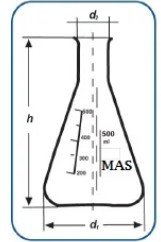
A borosilicate glass conical (Erlenmeyer) flask data sheet outlines the technical specifications, chemical resistance, and physical properties of standard 3.3 borosilicate laboratory glassware.
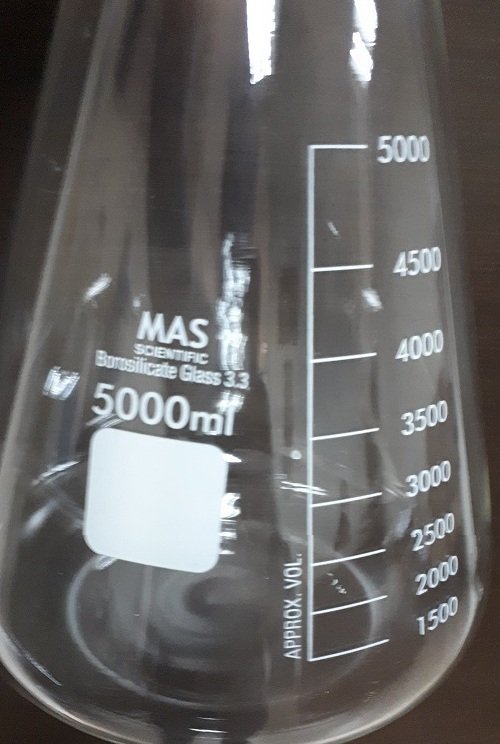
| MAS 1210-25 Glass Conical Flask Narrow Mouth, 25ml | MAS 1210-25 Glass Conical Flask Narrow Mouth, 50ml | MAS 1210-25 Glass Conical Flask Narrow Mouth, 100ml |
| MAS 1210-25 Glass Conical Flask Narrow Mouth, 250ml | MAS 1210-25 Glass Conical Flask Narrow Mouth, 500ml | MAS 1210-25 Glass Conical Flask Narrow Mouth, 1000ml |
| MAS 1210-25 Glass Conical Flask Narrow Mouth, 2000ml | MAS 1210-25 Glass Conical Flask Narrow Mouth, 3000ml | MAS 1210-25 Glass Conical Flask Narrow Mouth, 5000ml |
Technical Specifications (Example: 250ml Narrow-Neck Flask)
- Material: 3.3 Borosilicate Glass (high thermal and chemical resistance)
- Capacity: 250 mL (common sizes range from 25 mL to 2,000+ mL)
- Neck Style: Narrow-neck or wide-neck variants available.
- Graduations: White enamel or printed scale for approximate volume measurement
- Reinforced Rim: Yes, to increase mechanical strength and reduce chipping
- Standards & Compliance: Conforms to ISO 1773, ISO 3585, DIN ISO 1773, or DIN ISO 24450 equivalents
- Autoclavable: Yes, up to 121°C
- Material & Performance Characteristics
- Thermal Shock Resistance: Low coefficient of expansion allows safe handling under rapid temperature changes and heating over hotplates or bunsen burners (with wire gauze).
- Chemical Durability: High resistance to water, acids, salt solutions, organic solvents, and alkalis (Class 1 hydrolytic resistance).
- Thermal Expansion: The number
3.3refers to its mean linear thermal expansion coefficient of 3.3 × 10⁻⁶ K⁻¹ (measured between 20°C and 300°C). - Low Expansion Rate: It expands very little when heated—roughly one-third the rate of standard soda-lime glass—which prevents it from cracking under sudden temperature changes (thermal shock).
- Key Composition and Properties
- Composition: It is typically made of about 80% to 81% silica (SiO₂), 13% boron trioxide (B₂O₃), 4% alkali oxides (Na₂O/K₂O), and 2% aluminum oxide (Al₂O₃).
- Thermal Shock Resistance: It can safely handle rapid temperature differences of roughly 100°C to 160°C depending on the shape and wall thickness.
- Chemical Resistance: It is highly resistant to water, acids, halogens, and organic solvents, though it can be attacked by hydrofluoric acid, hot phosphoric acid, and strong alkalis.
- Common Uses
- Laboratory Glassware: Beakers, flasks, condensers, and test tubes.
- Industrial Plant: Corrosive chemical pipelines, process equipment, and reactor vessels.
- Pharmaceuticals: High-durability medical and industrial packaging