
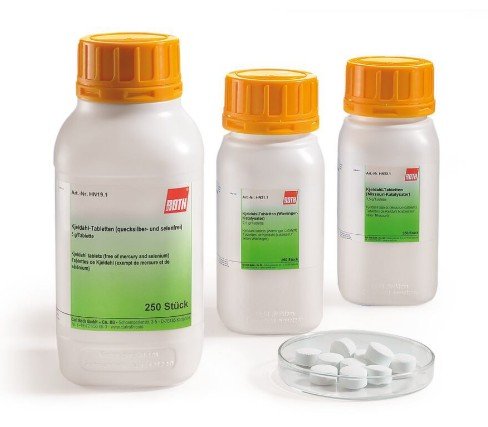
SKU: HN22.1Categories: Analysis of Food, Chemicals, Determination of Nitrogen according to Kjeldahl, Inorganic & Analytical ReagentsTag: 250pc(s)Brand: Carl Roth
Description:
Kjeldahl tablets, (Missouri-catalyst), tablet 2,5 g, Density (D) 2,7 g/cm³
Important Notice: For Research & Professional Use Only
Our products are intended strictly for scientific research, laboratory, and industrial applications. They are NOT for human or animal consumption, medical use, or any form of supplementation.
By purchasing from us, you confirm that you are a qualified professional and understand that improper use of these materials can pose serious health risks. We do not provide guidance or support for any use outside of their intended applications.
If you have any questions regarding the proper use of our products, please contact us before placing an order.
Lead Times
Carl Roth products lead times are dependant on stock levels.
Composition: acc. to Missouri (K2SO4, Na2SO4 and CuSO4).
General information
Determination of Nitrogen according to Kjeldahl
The most common technique for measuring the amount of nitrogen in organic matter is the Kjeldahl method, which is used in a wide range of sectors such as environmental analysis, food analysis, water analysis and agricultural analysis, as well as in the pharmaceutical and chemical industries. In this traditional method, a precisely weighed sample is broken down using concentrated sulphuric acid, a process which digests its organic contents and reacts nitrogen to form ammonium sulphate.(CHNO)(s) → CO2 (g) + SO2 (g) + H2O (g) + NH4SO4 (solv, H2SO4)A catalyst or catalyst mixture consisting of copper, selenium, mercury and/or titanium is added to speed up the reaction. Sodium or potassium sulphate is used to give the sulphuric acid a higher boiling point. If the nitrogen is contained in a nitro, nitroso or azo compound, however, the mixture must be reduced with zinc before digestion takes place.
The nitrogen is now present in the sulphuric acid as ammonium sulphate. Adding a strong base (such as NaOH) neutralises the sulphuric acid and liberates ammonia from the solution.NH4SO4 (solv) + 2 NaOH (aq) → Na2SO4 (aq) + 2 NH3 (g) + 2 H2O (l) The ammonia is led into an acid (such as boric acid) by means of steam distillation.B(OH)3 (aq) + 2 H2O (l) + NH3 (g) → B(OH)4– (aq) + NH4+ (aq) The resulting strong base (borate ion) is back-titrated with a strong acid (hydrochloric acid or sulphuric acid). The excess weak boric acid is not captured in the process. A Tashiro’s indicator that changes colour in the acid is used for titration. The amount of acid that has been used up can then be converted into the amount of nitrogen in the sample. NH4+ (aq) + B(OH)4– (aq) + HCl (l) → NH4Cl (aq) + B(OH)3 (aq) + H2O (l)To calculate the protein content of the sample, the varying nitrogen content of the amino acids must be checked and the relevant conversion factors applied. The nitrogen contained in food derives mainly from proteins, but different samples may also contain other sources of nitrogen.