
An Ostwald viscometer is a U-shaped glass capillary Instrument used to measure the kinematic viscosity of Newtonian Liquids by measuring the time a fixed volume takes to flow under gravity. Widely used in industry for liquids like oils, it compares the flow time of a test sample against a reference liquid (usually water) of known viscosity.
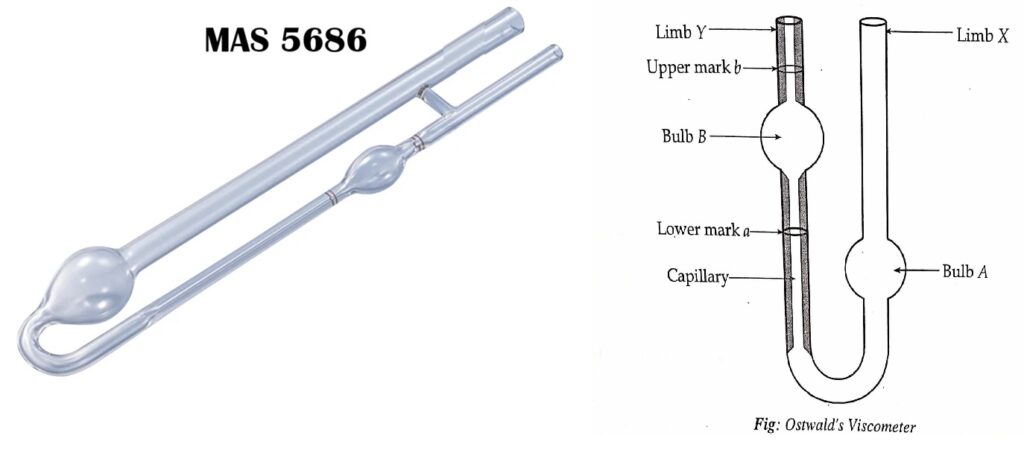
| Calibrated | Yes |
| Description | 0.6 mm diameter |
| Approximate Constant | 0.03 |
| Includes | Ring marks |
| Material | Glass |
| Length (Metric) | 290 mm |
| For Use With (Application) | Manual measurements |
| Volume (Metric) | 2 mL |
Falling-sphere viscometers

Stokes’ law is the basis of the falling-sphere viscometer, in which the fluid is stationary in a vertical glass tube. A sphere of known size and density is allowed to descend through the liquid. If correctly selected, it reaches terminal velocity, which can be measured by the time it takes to pass two marks on the tube. Electronic sensing can be used for opaque fluids. Knowing the terminal velocity, the size and density of the sphere, and the density of the liquid, Stokes’ law can be used to calculate the viscosity of the fluid. A series of steel ball bearings of different diameter are normally used in the classic experiment to improve the accuracy of the calculation. The school experiment uses glycerol as the fluid, and the technique is used industrially to check the viscosity of fluids used in processes. It includes many different oils and polymer liquids such as solutions[clarification needed].
In 1851, George Gabriel Stokes derived an expression for the frictional force (also called drag force) exerted on spherical objects with very small Reynolds numbers (e.g., very small particles) in a continuous viscous fluid by changing the small fluid-mass limit of the generally unsolvable Navier–Stokes equations:F=6πrηv,

whereF is the frictional force,r is the radius of the spherical object,η is the fluid viscosity,v is the particle velocity.
If the particles are falling in the viscous fluid by their own weight, then a terminal velocity, also known as the settling velocity, is reached when this frictional force combined with the buoyant force exactly balance the gravitational force. The resulting settling velocity (or terminal velocity) is given byVs=29r2g(ρp−ρf)μ,
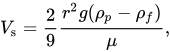
where:Vs is the particle settling velocity (m/s), vertically downwards if ρp > ρf, upwards if ρp < ρf,r is the Stokes radius of the particle (m),g is the gravitational acceleration (m/s2),ρp is the density of the particles (kg/m3),ρf is the density of the fluid (kg/m3),μ is the (dynamic) fluid viscosity (Pa·s).
Note that Stokes flow is assumed, so the Reynolds number must be small.
A limiting factor on the validity of this result is the roughness of the sphere being used.
A modification of the straight falling-sphere viscometer is a rolling-ball viscometer, which times a ball rolling down a slope whilst immersed in the test fluid. This can be further improved by using a patented V plate, which increases the number of rotations to distance traveled, allowing smaller, more portable devices. The controlled rolling motion of the ball avoids turbulences in the fluid, which would otherwise occur with a falling ball.[2] This type of device is also suitable for ship board use.[why?]
Ostwald Viscometer U-tube Capillary Viscometer for Fluid Viscosity Coefficient Measurement 1831
| 0.4mm | 0.5mm | 0.55mm | 0.7mm | 1.0mm | 1.5mm |
| 0.8mm | 0.85mm | 0.9mm | 0.5-0.6mm | 0.6mm | 0.57 – 0.6mm |